The Middle East property market: shifting investor behaviour and a window of opportunity
Amid geopolitical uncertainty, the Middle East property market is entering a new phase. Following several years of robust growth, record demand and a rapid rise in asset values, the market is beginning to operate under different rules. Investors are becoming more cautious, deals more rational, and the selection of properties more selective.
In recent years, the Middle East region, and the UAE market in particular, has attracted capital from all over the world. High returns, tax advantages, stable government policy and large-scale infrastructure development have created a powerful investment cycle. But any period of rapid growth inevitably leads to a phase of reassessment.
Whereas decisions were previously often made on the back of growth and expectations of quick profits, the focus is now on asset quality, liquidity, stable demand and a long-term holding strategy. This defines the logic of the current moment – not when to enter the market, but how to choose the right asset.
Why the market is entering a revaluation phase
The current dynamics of the Middle East property market represent a natural phase following a prolonged period of growth, which was also influenced by the geopolitical situation. In recent years, the UAE market has experienced a strong investment momentum: an influx of international capital, an increase in the number of residents, the launch of new projects and high buyer activity have created an environment in which prices in many segments have risen faster than fundamental indicators.
Growth was particularly pronounced in popular residential areas and the rental investment segment. High demand, limited supply and the activity of foreign buyers intensified competition. In many cases, transactions were concluded quickly, with decisions driven more by expectations of further growth than by in-depth analysis.
Transaction activity is now slowing down, largely due to geopolitical uncertainty in the region. This is a natural market reaction, which historically tends to be short-lived.
At the same time, expectations regarding returns are shifting. The focus is now on income stability, location quality and the long-term potential of the property. Investors are analysing supply levels, the area’s prospects, competition in the rental segment and the property’s liquidity more carefully. The market is shifting towards a more analytical decision-making model, which is considered a sign of maturity.
A slowdown is not a crisis, but part of the cycle
Property markets always develop in cycles: periods of strong growth are inevitably followed by phases of slowdown, after which a new equilibrium is established. In this context, the current situation in the UAE market calls for an understanding of market dynamics, rather than an emotional assessment.
The classic property cycle looks like this: growth, overheating, correction, stabilisation, new growth, and so on in a cycle. During the growth phase, the market attracts capital, demand increases, sales accelerate and prices rise. Then comes overheating – the moment when expectations begin to outpace fundamental indicators. After this, the market enters a correction phase, meaning activity slows, investors become more cautious, and prices in certain segments adjust.
The UAE property market is currently in a phase of correction and adjustment. This is most evident in the mass-market segment, where supply has grown significantly in recent years. In areas with a large number of new projects, competition is intensifying, and buyers are gaining more room for negotiation. The premium segment is showing a different dynamic — high-end properties in limited locations are maintaining their resilience thanks to stable demand and lower sensitivity to short-term fluctuations.
The banking sector provides additional stability to the market. Major banks are expanding their mortgage programmes, including financing during the construction phase once a property has reached around 30% completion — this supports demand even during a cooling phase.
Mature markets regularly go through such periods. A correction reduces overheating, redistributes capital and creates a more stable foundation for the next phase of growth. The key factor keeping the UAE market in the category of reliable investment destinations even during this period is a transparent legal system and consistent government policy towards foreign investors. These conditions explain why large institutional capital does not leave the region during the correction phase, but continues to operate there.
Types of investors in the current market
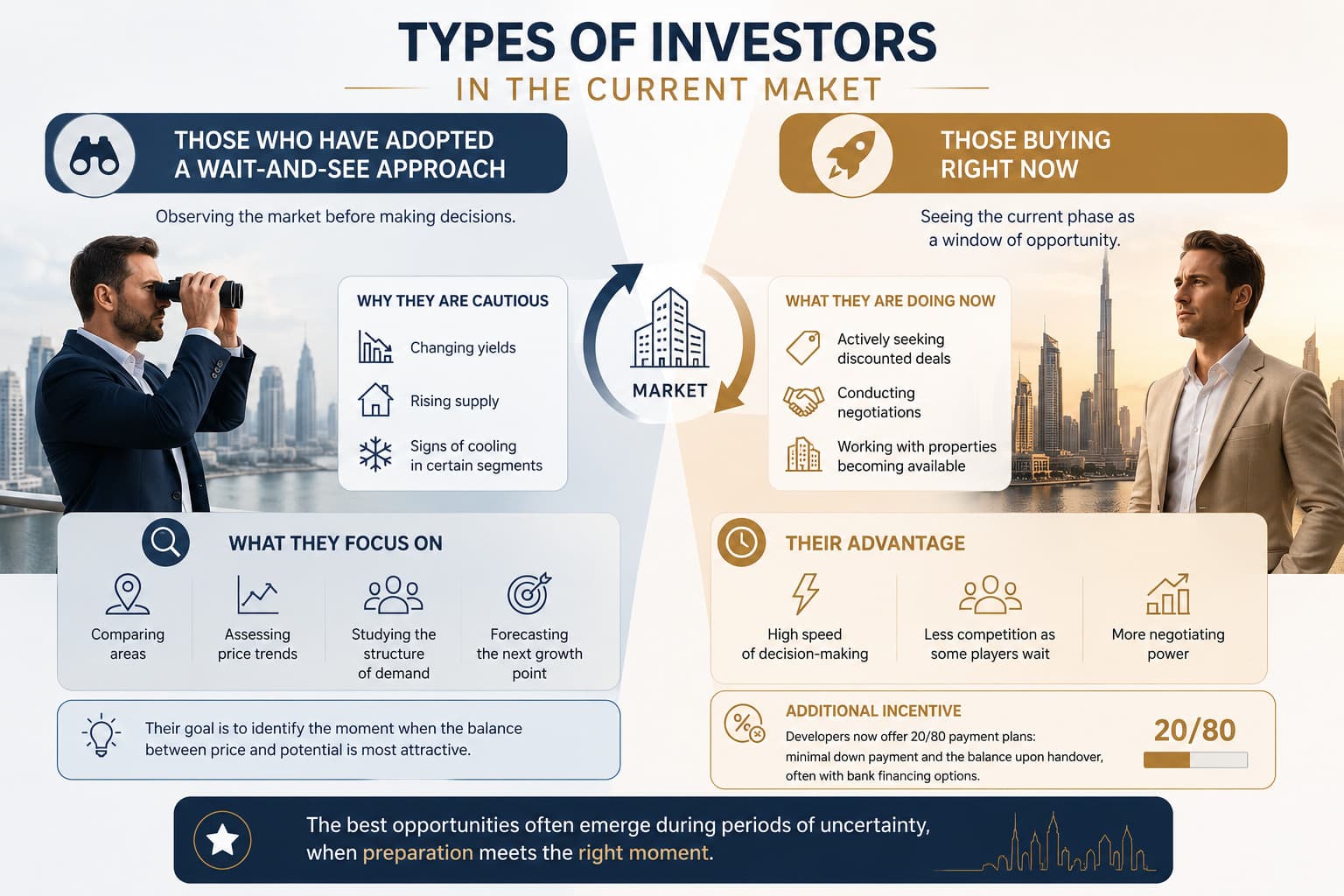
Against the backdrop of market restructuring, investors have ceased to act in unison. Whereas during the period of rapid growth most participants followed a similar strategy—entering the market quickly to capitalise on rising prices—behaviour has now become far more polarised.
Those who have adopted a wait-and-see approach
The first category comprises investors who have temporarily scaled back their activity. They are not leaving the market, but prefer to observe how the situation develops before making decisions.
This behaviour is largely understandable. Caution is mounting against a backdrop of changing yields, rising supply and signs of a cooling-off in certain segments.
This group of investors is carefully analysing the market: comparing areas, assessing price trends, studying the structure of demand and forecasting where the next growth point might emerge. For them, it is not simply a matter of buying a property, but of identifying the moment when the balance between price and potential is at its most attractive.
Those buying right now
The second category of investors operates differently. These are buyers who view the current phase not as a reason to wait, but as a window of opportunity.
Right now, they are actively seeking discounted deals, conducting negotiations and working with properties that are becoming available due to changes in market dynamics. This group is characterised by rapid decision-making: when a profitable asset appears, time becomes a critical factor.
These investors understand that the most attractive opportunities usually arise not during periods of growth, but in phases of uncertainty — when some players adopt a wait-and-see stance, competition eases, and negotiating scope widens.
An additional incentive for them is the change in terms offered by developers: instead of the standard 60–80% payment schemes during construction, 20/80 plans are now increasingly available — a minimal down payment and the principal amount upon handover, often with the option of bank financing.
Why institutional investors are stepping up their presence
One of the most important indicators for assessing the current market phase is the behaviour of large-scale capital. While retail investors may be guided by emotions, expectations or short-term trends, institutional players make decisions differently.
Today, more than twenty international investment funds are actively operating in the region, viewing UAE property as a strategic area for capital allocation. For a market that, just a few years ago, was perceived by parts of the global community as regional, this is a telling figure. We are not talking about short-term speculative deals, but about systematic engagement with development projects, ready-to-use commercial properties and large residential complexes.
Institutional capital assesses not short-term fluctuations, but fundamental indicators: macroeconomic stability, the regulatory environment and the region’s long-term potential. The UAE continues to meet these criteria: stable economic policy, a transparent regulatory system and a steady influx of businesses and residents make the market attractive even during a correction. Consequently, major funds are not scaling back their activity but, in some cases, are expanding their presence. Their strategy is based on a horizon of several years, not several months. A preference for entering the market during periods when price expectations are less overheated makes the current phase particularly interesting for them.
The fact that international funds are strengthening their presence is one of the strongest indicators of confidence in the market. Large capital does not enter by chance. It goes where it sees a stable system, clear rules of the game and potential for long-term growth.
How investment strategies are changing
The current market phase is changing both buyer behaviour and the structure of investment portfolios. Many investors no longer view property as a collection of individual properties, as the overall capital structure is what matters today.
Some owners are beginning to sell properties acquired during the period of active growth in order to reallocate capital and move into higher-quality assets. The main aim of such sales is not to exit property as an asset class, but to transition to a more sustainable ownership structure: fewer average properties, more liquid, rare or premium ones.
The reasons why owners are willing to sell at a discount are not linked to panic, but to a shift in investment logic. Some are freeing up capital to use it in new segments or more promising assets. Others are critically reviewing their portfolios: how resilient a property is to market fluctuations, how quickly it can be resold, and whether it retains demand in the long term. Others are deliberately shifting towards premium and trophy properties — real estate with limited supply, high status and greater resilience to market fluctuations.
What is happening in the rental sector and how to adapt
The rental market is one of the first to react to changes in the investment cycle. Whilst during periods of strong growth many properties delivered high returns regardless of their type or location, the situation is now becoming more selective. Yields remain stable, but the market demands a more precise asset management strategy.
Decline in short-term rental yields
Over the past few years, the short-term rental segment has expanded rapidly. Many investors focused specifically on daily rentals, expecting higher returns compared to the traditional long-term model. This format developed particularly rapidly in popular tourist and central areas.
However, high returns led to a predictable outcome — the market became saturated. The number of properties geared towards short-term rentals increased significantly, and competition among owners intensified.
Now, some properties are facing longer periods of vacancy, particularly standard flats without a distinct competitive advantage. It is no longer enough simply to have a property in a popular location; what matters is the quality of management, the level of service, the uniqueness of the offering and correct positioning.
How investors are adapting their strategy
Against the backdrop of these changes, some owners are beginning to rethink their ownership model. One of the most notable trends is the shift towards long-term rentals as a more sustainable and predictable format. This allows for lower operating costs, reduced dependence on seasonality, and a more stable cash flow.
At the same time, the approach to calculating investment performance is changing. Whereas previously many focused on maximum potential returns, today real occupancy rates, management costs, maintenance and marketing expenses are increasingly taken into account.
The importance of choosing the right area is also growing. In a more competitive market, locations with consistent demand from residents demonstrate resilience: areas with developed infrastructure, convenient transport links and a stable residential environment.
For owners of properties geared towards short-term rentals, the current situation does not mean they need to exit the segment immediately. Rather, it is a matter of adjusting strategy. In practice, this might look like:
a shift to a mixed model — a combination of short-term and medium-term rentals;
working with corporate tenants, who provide longer-term and more stable occupancy;
repositioning the property to target a narrower, more affluent audience;
a shift towards long-term lettings in areas with stable residential demand.
In the current phase, it is not those who simply own property who are benefiting, but those who know how to adapt their management model to changing demand.
Sectors with growth potential: retail and hotels
Against the backdrop of a cooling in certain residential sectors, investors’ attention is gradually shifting towards alternative property formats. Commercial properties and the hotel sector are becoming an increasingly prominent part of investment strategies, particularly for those taking a long-term view of the market.
Commercial property
Even despite the unstable situation, the UAE continues to attract international companies, entrepreneurs and new businesses, creating a steady demand for offices, retail space and mixed-use developments.
One factor supporting the market remains the requirement for many companies to have a physical office for registration. This creates structural demand that is less dependent on fluctuations in the investment market and persists even during periods of cooling.
Commercial property is characterised by a more predictable yield model. Long-term leases, corporate tenants and high payment stability make this segment attractive to investors seeking a stable cash flow. The most sought-after properties are office spaces, mixed-use developments and retail properties in business clusters with a high concentration of businesses.
Hotel property
The hotel segment is undergoing its own phase of transformation. The performance of these assets depends on the level of management, brand, occupancy and operating model — this makes the segment less versatile and requires more in-depth analysis before entering.
At the same time, a window of opportunity is opening up right now. During the period of active growth, the entry threshold into the hotel segment was significantly higher: many assets were valued against a backdrop of heightened demand and limited supply. Today, there are more opportunities for negotiation, and some properties are coming to market on terms that were previously virtually unattainable.
Investors are beginning to view hotel property as a long-term asset capable of benefiting in the future from the development of tourism, international events and an increase in the number of visitors to the region.
When comparing the two segments, commercial property is more often perceived as a more stable investment with a predictable cash flow. Hotel assets, by contrast, can offer higher returns but require greater involvement and are sensitive to operational factors. This is precisely why both sectors are increasingly viewed not as an alternative to residential property, but as a complement to an investment portfolio and a tool for risk diversification and the search for new sources of returns.
Why diversification is becoming a key strategy
During periods of market crisis, it is not only investor behaviour that changes, but also the approach to capital management. Whilst during periods of active growth many focused on a single segment — most often residential property — it is now becoming clear that portfolio stability is determined not by the number of assets, but by the quality of risk distribution.
Different segments react to market changes in different ways. Residential property depends on population migration and rental demand; commercial properties depend on business activity; and hotel assets depend on tourism and international visitor flows. Combining several sectors makes a portfolio more resilient, whilst different yield horizons allow it to remain unaffected by short-term fluctuations: some assets provide a stable cash flow, whilst others are geared towards long-term capital appreciation.
This approach is particularly relevant in the UAE market, where different types of property, investment models and capital utilisation scenarios are present within a single region.
What a balanced portfolio might look like
An effective investment portfolio is built on the principle of distributing functions across assets. The foundation can be residential property for long-term letting, as the most stable instrument with predictable demand. It provides regular income and relatively low volatility.
The next element could be a commercial property: office space, retail or mixed-use space. Commercial property adds stability to the portfolio through corporate tenants and long-term contracts. This represents a different approach to yield, which complements the residential segment well.
An additional component could be a stand-alone property for short-term lets, but in a proven location with high demand stability. Unlike the mass market for daily rentals, such an asset, if chosen correctly, maintains occupancy even during market downturns.
Some investors are also considering diversification across countries in the region — combining assets in the UAE with properties in other parts of the Middle East, where the market is at a different stage of the cycle.
The main objective of diversification is not simply to spread capital, but to create a system in which different assets offset each other’s fluctuations.
What is supporting the market in the current phase
Current market dynamics suggest that the coming months will be a phase of gradual adjustment, which does not imply a weakening of fundamental demand. In segments with high competition and oversupply, buyers now have more room for negotiation.
Limited supply and stable long-term demand support prime locations even during periods of general cooling. In the short term, the market may move sideways — without sharp spikes, but also without a significant decline.
The autumn business season plays a historically important role. It is in the second half of the year that investment activity intensifies in the UAE: international business returns, the number of negotiations increases, and funds and corporate buyers become more active. This is traditionally a period of heightened business activity.
A change in the quality of transactions is already noticeable: there are fewer emotional purchases, and the proportion of strategic decisions is growing. Investors are paying greater attention to analysis, the structure of returns and the liquidity of the property.
The institutional environment of the UAE remains a key factor in the market’s stability. Consistent government policy, a transparent legal system, a high level of investment protection and international openness continue to build confidence in the region.
How the role of estate agents is changing in this new market phase
As the market becomes more complex, the role of estate agents is also changing. During periods of rapid growth, a broker’s primary task was often to facilitate a transaction quickly. Today, that is no longer enough.
Investors need not just access to properties, but an understanding of market dynamics, risk assessment and assistance in choosing a strategy. This is particularly important during a crisis, when the number of options is growing and the cost of making a mistake is rising.
Modern agencies are moving away from traditional brokerage towards investment consultancy. The focus is shifting towards selecting assets to meet specific requirements, analysing a property’s potential, and identifying opportunities that are not always publicly available. Working with owners interested in liquidity or willing to discuss a discount is particularly valuable: such deals often present the best entry points. This requires an understanding of sellers’ motivations, access to off-market listings, and the ability to manage non-standard negotiations.
At Mayak Real Estate, this is exactly how we operate. Property selection, analysis of ownership scenarios, transaction support and risk assessment — for us, this is a single strategic service, not a series of separate steps. Because in the current market phase, an investor needs not just a broker, but a partner who understands their objectives.
Conclusions
For investors, the current moment requires an understanding of the market structure and a readiness to act with awareness, rather than waiting for the perfect entry point. The advantage goes to those who view the current situation as an environment in which opportunities arise that were unavailable at the peak of growth.
The UAE continues to maintain its status as one of the region’s most stable investment ecosystems. The crisis period could present a good opportunity to enter this market for those prepared to identify the best entry points.